
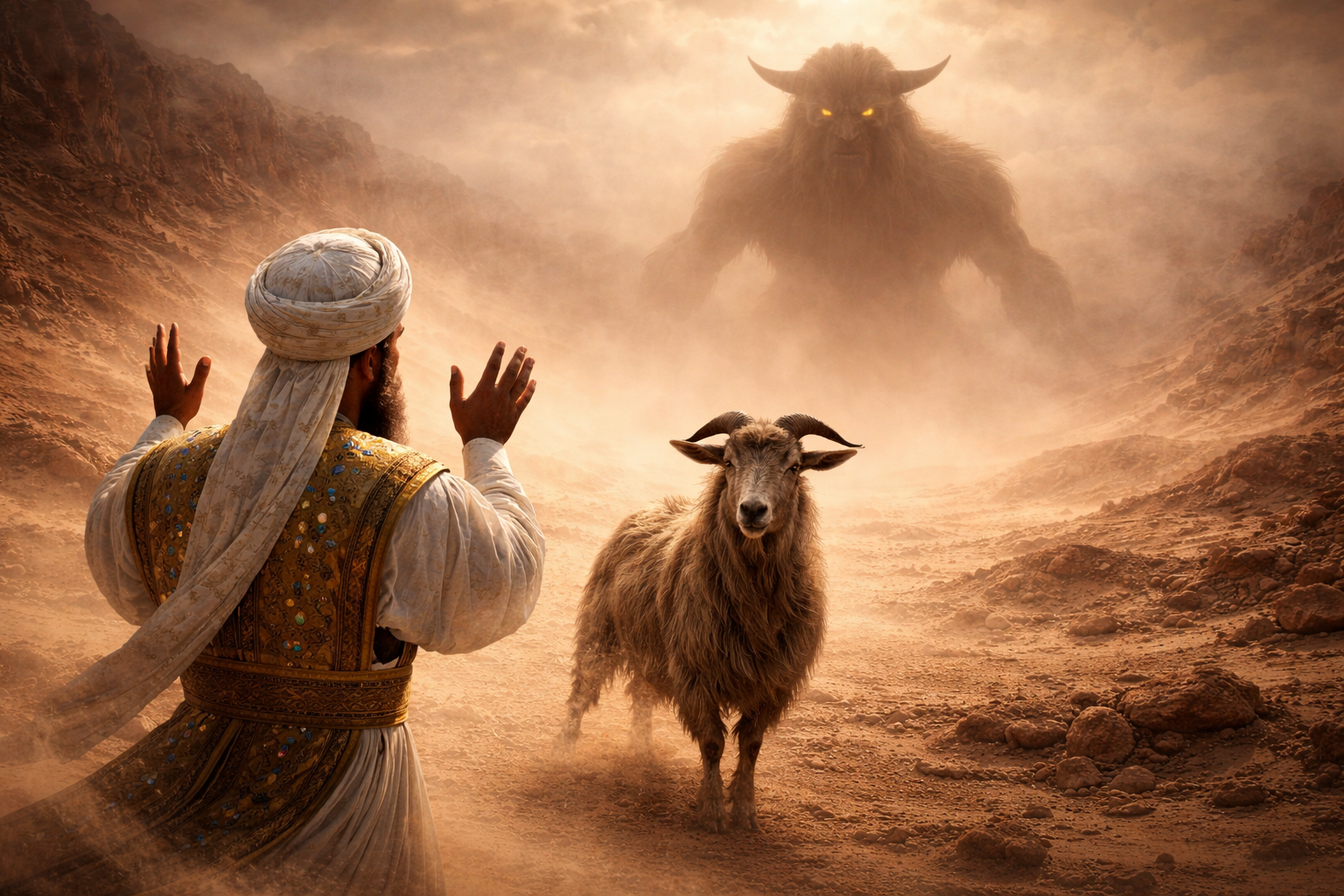
Leviticus doesn’t exactly top most people’s Bible reading lists. It’s dense, repetitive, and filled with blood, sacrifices, and regulations that can feel disconnected from modern life. But chapter 16 — the Day of Atonement — contains one of the most theologically rich rituals in all of Scripture. And buried inside it is a name that should raise some eyebrows: Azazel.
Not Just a Scapegoat
The Day of Atonement (Yom Kippur) was one of the seven feasts of Israel and arguably the most significant event on the Levitical calendar besides Passover. On this day, the High Priest would go through an elaborate cleansing process before entering the Holy of Holies. As part of the ceremony, two goats were presented before the people. Lots were cast to determine each goat’s fate — one would be offered as a sacrifice to the Lord, and the other would be sent out into the wilderness.
Leviticus 16:7-10 – Then he shall take the two goats and set them before the Lord at the entrance of the tent of meeting. And Aaron shall cast lots over the two goats, one lot for the Lord and the other lot for Azazel. And Aaron shall present the goat on which the lot fell for the Lord and use it as a sin offering, but the goat on which the lot fell for Azazel shall be presented alive before the Lord to make atonement over it, that it may be sent away into the wilderness to Azazel.
The King James Version translates “Azazel” as “scapegoat,” which is where we get that modern phrase. But this is one place where the KJV misses the mark. The goat is not being sent to itself — Azazel is a proper name, just as “the Lord” is a proper name. One lot for the Lord. One lot for Azazel. The grammar is parallel and intentional.
So who is Azazel?
Azazel in the Book of Enoch
The word Azazel only appears four times in Scripture, all within Leviticus 16. There’s no other biblical passage to cross-reference for a definition. But that doesn’t mean the original audience didn’t know exactly who this was.
The Book of Enoch — a Jewish text quoted directly in the New Testament book of Jude — provides crucial background. (Despite some modern fearmongering surrounding this work, the Book of Enoch is safe to read, especially its earliest chapters). In Enoch chapter 8, Azazel is identified as one of the Watchers, a group of fallen Sons of God who descended to earth in the pre-flood era. According to Enoch, Azazel taught humanity forbidden knowledge: metallurgy, weaponry, and cosmetics — things that contributed to widespread corruption and violence in the ancient world.
In Enoch chapter 10, God responds to the chaos the Watchers caused. He instructs the angel Raphael to bind Azazel and cast him into a spiritual prison in the desert wilderness:
“Bind Azâzêl hand and foot, and cast him into the darkness: and make an opening in the desert, which is in Dûdâêl, and cast him therein. And place upon him rough and jagged rocks, and cover him with darkness, and let him abide there for ever, and cover his face that he may not see light. And on the day of the great judgement he shall be cast into the fire.”
Azazel is bound in the wilderness — not in a deep, sealed prison, but close enough to observe the world without being able to act. He’s out there, somewhere in the desert, waiting for the final judgment.
God’s concluding words in that chapter are striking: “The whole earth has been corrupted through the works that were taught by Azâzêl: to him ascribe all sin.”
Remember that: “to him ascribe all sin.”
Two-Way Atonement
Here’s something that often surprises people when they study the Levitical system: the regular sacrifices described in Leviticus chapters 1-7 only covered unintentional sins. There were no sacrifices available for willful transgressions or iniquities. For that, there was only one day on the calendar — the Day of Atonement.
This is where the two-goat ritual becomes so significant. The first goat, sacrificed to the Lord, represented cleansing — the transfer of God’s purity to the people. But that’s only half of what atonement requires. Where do the sins actually go?
The High Priest would lay both hands on the head of the second goat and confess over it all the iniquities, transgressions, and sins of the people. Then that goat was released into the wilderness — carrying the full weight of Israel’s wrongdoing out to where Azazel lay bound.
Leviticus 16:21-22 – Aaron shall lay both his hands on the head of the live goat, and confess over it all the iniquities of the people of Israel, and all their transgressions, all their sins. And he shall put them on the head of the goat and send it away into the wilderness… The goat shall bear all their iniquities on itself to a remote area.
This wasn’t a sacrifice offered to Azazel. It wasn’t appeasement of a demon. It was more like a verdict being delivered. “Azazel, since you started all of this, the record of Israel’s sin is being added to yours.” The people’s iniquities weren’t just forgiven and forgotten — they were formally transferred. The clean record of the Lord’s goat applied to the people; the people’s corrupt record was sent out to the one who introduced that corruption in the first place.
That is two-way atonement. And it’s the only kind that actually works.
Two Sons of God
The Day of Atonement doesn’t end in the Old Testament. It also finds its fulfillment at the crucifixion of Christ.
When Jesus stood before Pilate, Pilate could find no legitimate reason to execute Him. So he did what was customary at Passover — he offered to release one prisoner. He presented two men before the crowd: Jesus, who was sinless, and Barabbas, a rebel and murderer.
Two men, presented before the people. One pure. One with a record of violence and crime.
The name Barabbas is itself striking — Bar means “son,” and Abba means “Father.” Barabbas: Son of the Father. Two sons of the father, standing before the crowd. And the chief priests persuaded the people to choose Barabbas.
The pure one was condemned. The guilty one went free.
Jesus also bled from exactly seven locations during His crucifixion: His head (the crown of thorns), His back (the scourging), His hands, His feet, and His side (the spear). Seven points of blood — corresponding to the High Priest sprinkling the blood of the pure goat seven times at the altar on the Day of Atonement.
Fulfilled at the Cross
And ultimately, Jesus fulfilled both roles. He was the pure goat — His righteous record transferred to those who believe. But He was also the Azazel goat — bearing the full weight of human iniquity, carried away from the camp, dying outside the city.
2 Corinthians 5:21 makes this plain – For our sake he made him to be sin who knew no sin, so that in him we might become the righteousness of God.
Azazel was a fallen Son of God. For over a thousand years, Israel’s sins were symbolically ascribed to him through this annual ritual. But at the cross, a different Son of God took that role — not as a fallen rebel, but as a willing substitute. The iniquities that belonged to us were transferred to Him (to Him ascribe all sin). And this divine trade- prefigured in the Day of Atonement- is what makes our salvation possible.
Isaiah 53:5 – …upon him was the chastisement that brought us peace,
and with his wounds we are healed.
To learn more about this ritual, listen to this episode of the Weird Stuff in the Bible podcast. And subscribe today to check out our entire Book of Enoch series that we’re undertaking in 2026. You can also read the book of Enoch online here: https://sacred-texts.com/bib/boe/index.htm
Leave a Reply