
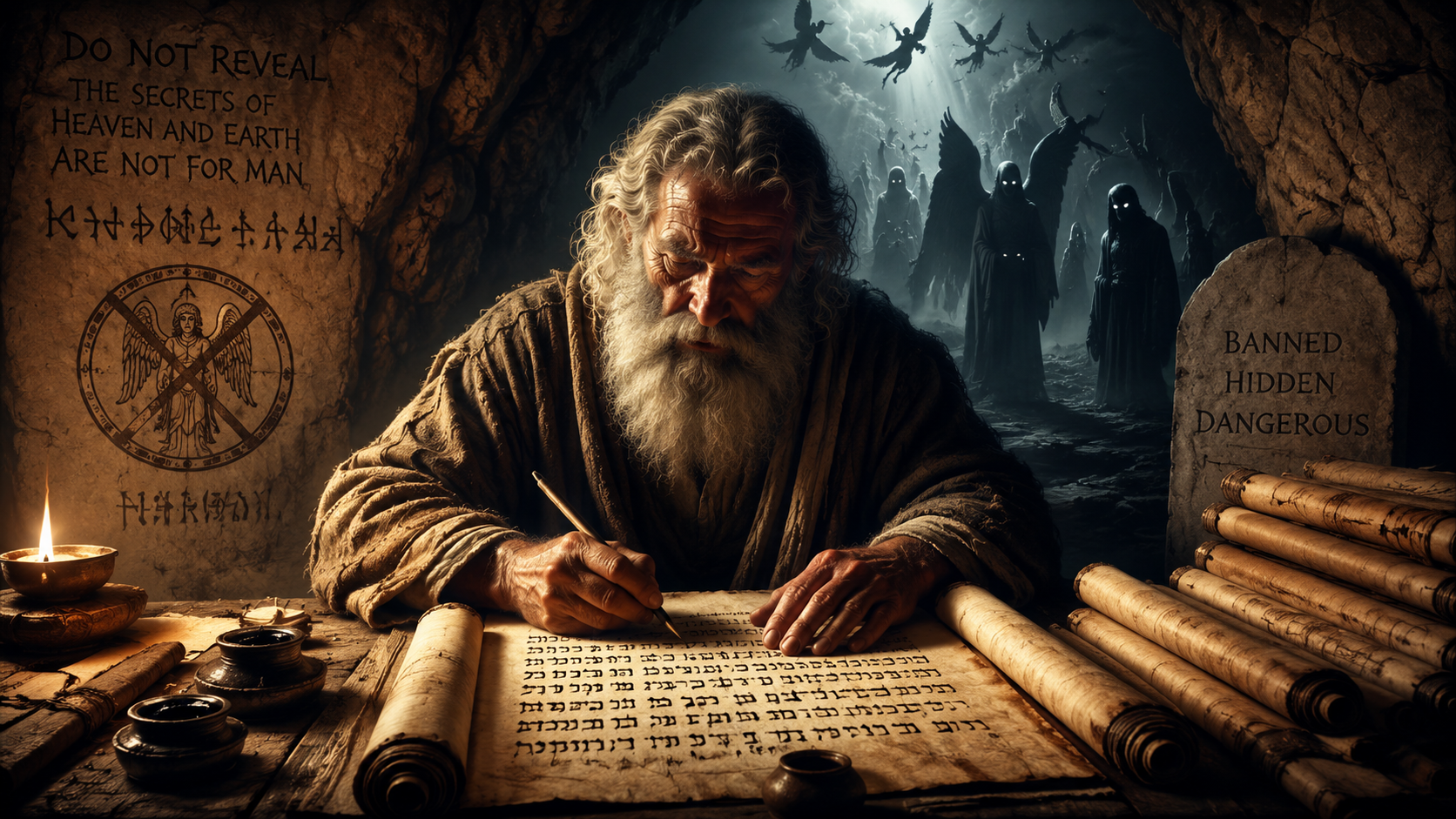
You will often hear people claim that it’s dangerous for Christians to read the Book of Enoch. That’s literally the word they use. Dangerous.
If I thought the Book of Enoch was dangerous to read, I wouldn’t have spent the first six months of this year studying it. But now that I have, I would say I can identify three fair criticisms some might have to studying it—followed by three reasons why I think Christians should read it anyway.
Three Dangers of the Book of Enoch
1. Enoch has a different emphasis on sin than the Bible does.
The Book of Enoch is largely about the Watchers — the Sons of God from Genesis 6 who lusted after women, came to earth, created the giants, and taught forbidden knowledge to mankind. Enoch’s book places most of the blame for humanity’s pre-flood problems on these spiritual beings.
The Bible, on the other hand, emphasizes human sin.
Now hear me clearly: a different emphasis is not a contradiction. Both can be true at once. Kings and Chronicles tell the same story with different emphases—one on northern Israel and one on southern Israel. The four Gospels tell about the same Jesus from four different angles—such as Matthew emphasizing Jesus as the Jewish Messiah, Luke emphasizing His humanity, John emphasizing His divinity. In the same way, Genesis and Enoch tell the same story—but Genesis was written with a focus on humans, and it wants us to take responsibility for our part in how things went wrong.
So if you read the Book of Enoch and conclude, “I guess I can just blame the Watchers for all our problems,” you’ll get off-track in your thinking. Just like with the reality of demons and the devil, we can be honest about the influence of spiritual beings while still taking responsibility for our own sin. Just like you can’t say “the Devil made me do it,” you can’t blame Azazel either.
2. Don’t elevate it to the level of Scripture.
Enoch is not the Bible. And despite what some may say, it is not a lost book of the Bible. Remember these words from Jesus:
Matthew 24:35 – “Heaven and earth will pass away, but my words will not pass away.”
For nearly 2,000 years, the Book of Enoch passed away. It was lost from the church. A few hundred years ago it was rediscovered in Ethiopia, and then again among the Dead Sea Scrolls in the 1940s.
Jesus also said in Matthew 5:18 that not a single letter of Scripture would be lost in its preservation. We can’t say that about Enoch. There are occasional missing words. Enoch 7 gives the height of the giants as 3,000 ells—which is clearly an ancient typo, since the giants were roughly 10-13 feet tall, not 3,000 of anything. So we can take Enoch as generally reliable, but not perfect.
Lots of pastors and scholars read ancient books (like Josephus’s Antiquities) as background for understanding Scripture without elevating those writings to the level of the Bible. The Book of Enoch should be no different.
3. Don’t accept everything that has Enoch’s name on it.
Is the book of Enoch genuine? It’s not a simple yes-or-no question. There are actually three books that go by the name of Enoch. Unfortunately, most editions you buy on Amazon package all three together—but II and III Enoch don’t belong in the same conversation as I Enoch.

The introduction to the Modern Standard Version of the Book of Enoch sums up why: “Other ancient texts have been discovered that falsely claim a connection to Enoch. One is the Slavonic Enoch, also called The Secrets of Enoch. Another work is the Hebrew Enoch, also called The Revelation of Metatron. Both of these fictional works were created after the birth of Christianity and had no connection to the ancient person of Enoch or to the Book of Enoch. Scholars labeled these works 2 Enoch and 3 Enoch for academic distinction, but this is confusing and creates the false impression that all three works are connected. We should now erase these ties.”
Even within I Enoch’s 108 chapters, credibility exists on a spectrum. The first 36 chapters—called The Book of the Watchers—are by far the most reliable. We know they predate Jesus. Jude cites them directly. That’s about as strong an endorsement as you can get. The later chapters are more debatable.
Three Reasons Christians Should Read It Anyway
1. Jesus and the New Testament writers believed it.
Jude 14 – It was also about these that Enoch, the seventh from Adam, prophesied, saying, “Behold, the Lord comes with ten thousands of his holy ones…”
As a Christian who believes in biblical inerrancy, I have to take that attribution seriously. If Jude was wrong about who wrote this book, the Bible has an error in it—and I don’t believe that. Paul, Peter, and Jesus also refer to information from Enoch’s book. These facts can’t be glossed over.
2. The New Testament uses it to teach doctrine.
The story of the Watchers is foundational to how the New Testament authors explain their theology and ethics.
Paul refers to it in I Corinthians 11 when discussing headship and authority. Peter refers to it in II Peter 2 to explain how God judges the wicked without destroying the righteous. He refers to it again in I Peter 3 to teach about baptism. Jude refers to it to explain why transgressing God’s boundaries brings judgment.
If you don’t have that background, you’ll read “because of the angels” and have no idea what Paul was talking about. You’ll wonder why certain angels are described as being locked in chains in Tartarus while others apparently roam free. Enoch fills in those gaps in our comprehension of the spiritual realm.
3. It helps you understand your Bible.
Scripture is sufficient for all matters of faith and godliness—II Peter 1 and II Timothy 3 are clear on that. But does Scripture always explain itself? I would say no. Sometimes you need outside sources to understand the world (and worldview) in which the Bible was written.
The Bible itself regularly utilizes extrabiblical texts for background information. Paul relied on the Talmud to know the names of Pharaoh’s magicians who opposed Moses (II Timothy 3:8). Jude also relies on the Targum Pseudo-Jonathan and The Testament of Moses to cite a story in which Satan fought Michael over the body of Moses. And in regard to the Book of Enoch itself, it’s impossible to know who Azazel is in Leviticus 16 from Scripture alone. The Bible never explains who he is; you have to read the Book of Enoch to find out why he comes up in the Day of Atonement ritual.
So yes, there are dangers with taking Enoch too far—but there are dangers with taking anything too far. The book itself isn’t the problem. And when Christians refuse to engage with it at all, they cut off an avenue for understanding Scripture that the New Testament writers themselves clearly valued.
Keep the right emphasis. Don’t elevate it above Scripture. Be selective about which parts you trust. And then read it.
If the writers of the New Testament relied on it, then it seems kind of silly to say it’s dangerous for us to look at it today. If it was good enough for Jude, Peter, Paul and Jesus, then it’s good enough for you and I.
Check out our 2026 exploration of the Book of Enoch on the podcast, starting with this episode:
Leave a Reply