
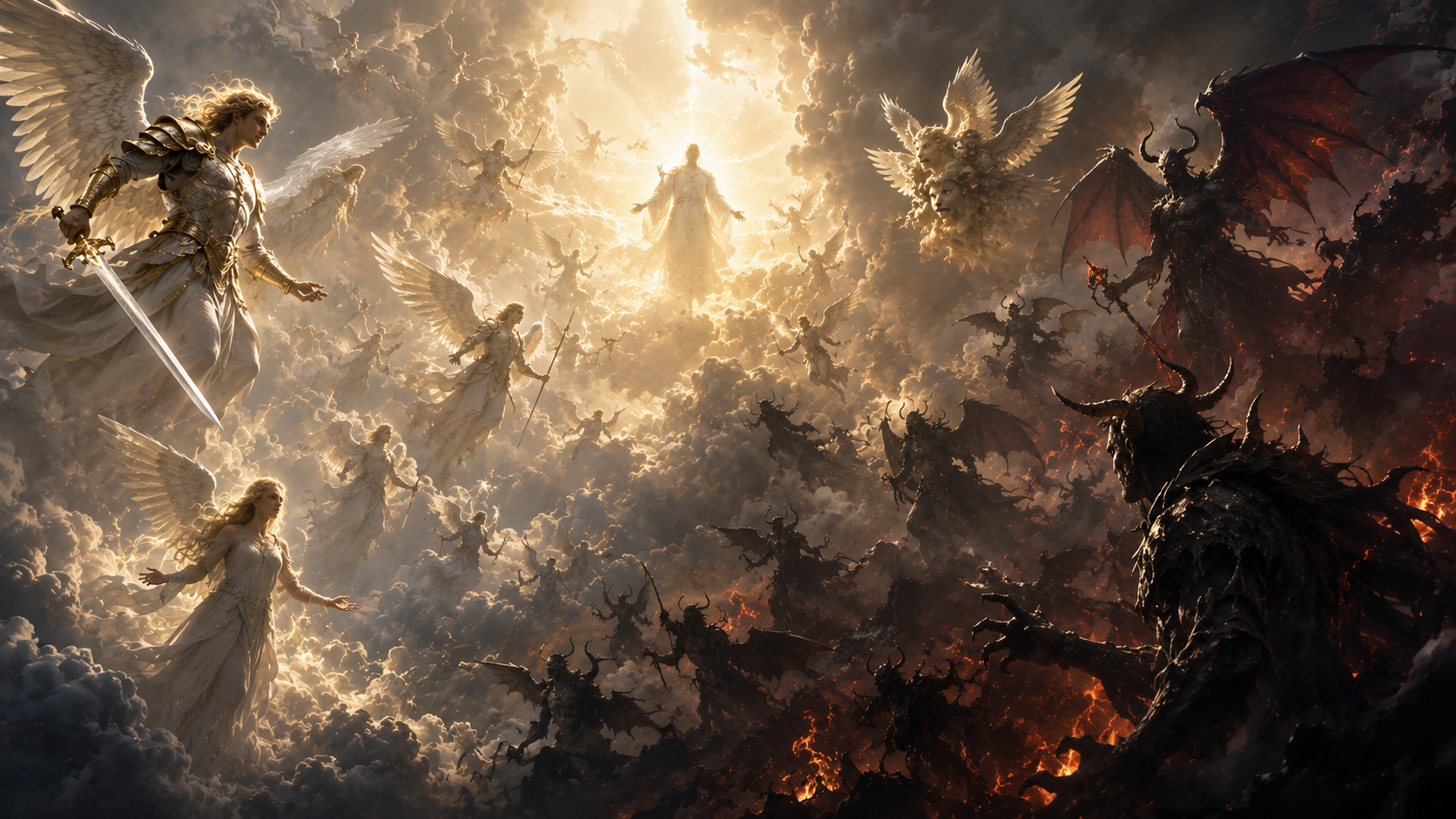
This is an ongoing catalog of every named spiritual being mentioned in Scripture. It will be updated as new entries are identified. If you know of any named spirits in the Bible that should be included, please email me or get in touch through the form on the Contact page.
A few notes before diving in:
- This catalog identifies named or individual spirits specifically. General spirits such as “a lying spirit” (I Kings 22:22), “spirit of fear” (II Timothy 1:7) or “evil spirit” (I Samuel 16:14) are too vague to assign a specific identity and are excluded.
- This is a catalog of named beings, not a survey of spiritual being types. Seraphim and Cherubim, for example, are not included unless a specific individual is identified- such as Satan, who was a Cherub.
- When possible, entries specify what type of being a spirit is, rather than defaulting to “angel” or “demon” as catch-all labels.
- The categories of “good” and “evil” are sometimes subjective. God is sovereign even over evil spirits and at times uses them to accomplish His will (for example, Psalm 78:49 describes God sending “evil angels” upon Egypt during the plagues). “Good” and “bad” in this catalog refer primarily to a being’s assumed loyalty in the spiritual realm.
One more preliminary note: Are false gods simply figments of human imagination (Isaiah 44:9-20), or do they correspond to actual beings in the spiritual realm who desire the worship of humans (I Corinthians 10:20)? Both are probably true in different cases. In this record, false gods who are marked for destruction in the Scriptures will be treated as real beings acting in rebellion against God and seeking worship for themselves (Psalm 82). It seems unproductive for God to threaten or pronounce judgment on beings that don’t exist.

Good Spiritual Beings
Michael
Michael is an archangel (June 9) and the principality over Israel (Daniel 10:21). He is specifically tasked with opposing Satan (Revelation 12:7-9, Jude 8-10) and will later chain him up in the abyss during the Millennium (Revelation 20:1).
Gabriel
A prominent angel in Scripture, Gabriel is often tasked with delivering messages of major significance (Daniel 8:16 and 9:21, Luke 1:19 and 26). He also pronounced a judgment on Zechariah, the father of John the Baptist, preventing him from speaking until his son’s birth.
According to the Book of Enoch, Gabriel is one of the seven archangels of heaven.
The Destroyer
An angel tasked with visiting destruction upon God’s enemies. He is not given a personal name in Scripture; he is simply known as “The Destroyer.” He is the death angel who visited Egypt and smote the firstborn of every house during the tenth plague.
Hebrews 11:28 – By faith he [Moses] kept the Passover and sprinkled the blood, so that the Destroyer of the firstborn might not touch them.
The Destroyer is also credited with killing some of the rebellious Israelites during the wilderness wanderings.
I Corinthians 10:10 – [We must not] grumble, as some of them did and were destroyed by the Destroyer.
Though his work is destructive in nature, he operates under God’s authority in his recorded actions.
Isaiah 54:16 (NIV) – [God speaking] And it is I who have created the destroyer to wreak havoc…
God decides where the Destroyer will be unleashed. He threatened to deploy this angel against Moab:
Jeremiah 48:8 – The destroyer shall come upon every city,
and no city shall escape;
the valley shall perish,
and the plain shall be destroyed,
as the Lord has spoken.
It is possible that this being is the same as the angel of the Abyss named Abbadon/Apollyon in Revelation 9. (Apollyon means “The Destroyer” in Greek). However, there are reasons to keep them distinct. See the Abaddon entry below.
The Angel of the Lord
A being who appears throughout the Old Testament and is widely understood to be a pre-incarnate appearance of Jesus. The case for this identification is strong: the Angel of the Lord accepts worship (Judges 6:18-21), something God’s loyal angels refuse to do (Revelation 19:10). Furthermore, Scripture speaks of The Angel of the Lord interchangeably with the Lord Himself (Judges 6:12-14).
Notable appearances include Exodus 3:2-6, Judges 13:2-23, Genesis 22:11-18. He is also credited with slaying an entire Assyrian army in a single night:
II Kings 19:35 – And that night the angel of the Lord went out and struck down 185,000 in the camp of the Assyrians. And when people arose early in the morning, behold, these were all dead bodies.
The Commander of the Lord’s Army
See above. Also seems to be a pre-incarnate appearance of Jesus and the same figure as the Angel of the Lord.
Joshua 5:13-15 – 13 When Joshua was by Jericho, he lifted up his eyes and looked, and behold, a man was standing before him with his drawn sword in his hand. And Joshua went to him and said to him, “Are you for us, or for our adversaries?” 14 And he said, “No; but I am the commander of the army of the Lord. Now I have come.” And Joshua fell on his face to the earth and worshiped and said to him, “What does my lord say to his servant?” 15 And the commander of the Lord’s army said to Joshua, “Take off your sandals from your feet, for the place where you are standing is holy.” And Joshua did so.
Two details link this figure to the Angel of the Lord: he declares the ground holy, echoing the words to Moses at the burning bush (Exodus 3); and he appears with a drawn sword, matching the Angel of the Lord in Numbers 22:23 and I Chronicles 21:16.

Evil Spiritual Beings
Satan / the Devil / Lucifer / Baal / Bel / Beelzebub
Known by many different names and identities (Revelation 12:9), the leader of all the demons (Mark 3:22-23) is Satan. The name “Satan” means “accuser” or “adversary.” He was originally a cherub anointed to serve as a guardian in the Garden of Eden (Ezekiel 28:14). But his heart became lifted up in pride (Isaiah 14:13-14) and he tempted Adam and Eve into sin (Genesis 3:1-6), seeking to seize their God-given dominion over the earth.
Genesis 3 introduces Satan as the “serpent.” In Hebrew, this word is nachash. It carries three layers of meaning worth noting:
- As a noun, nachash means “serpent” or “snake”
- As a verb, nachash means “deceive”
- As an adjective, nachash means “shiny,” “bright” or “luminous”
Satan is also identified with Baal/Bel, the most famous false god of the Old Testament. His doom is repeatedly confirmed throughout the Bible:
Jeremiah 51:44 – And I will punish Bel in Babylon,
and take out of his mouth what he has swallowed.
The nations shall no longer flow to him;
the wall of Babylon has fallen.
Jesus often refers to Satan as the prince of this world- indicating he is the principality spirit over all of fallen humanity (John 12:31, 14:30, 16:11). This means that all other evil principalities ultimately answer to him, just as any good principalities such as Michael answer to God.
Since the demons themselves answer to Satan, opposition to his demonic forces is equated with engaging Satan himself (Matthew 12:24-28).
I Peter 5:8 – Be sober-minded; be watchful. Your adversary the devil prowls around like a roaring lion, seeking someone to devour.
While his great sin was pride, we can resist him by humbling ourselves (I Peter 5:6-8, James 4:6-7).
Lilith
While Scripture is replete with feminine false gods (Asherah, Ishtar, the Queen of Heaven), it’s rare that one is verified as a genuine entity. Lilith- erroneously rendered “the night bird” in some translations- is one of those beings. Isaiah refers to her by name in a passage that decries numerous spiritual beings.
Isaiah 34:14 (AMP) – The creatures of the desert will encounter jackals
And the hairy goat will call to its kind;
Indeed, Lilith (night demon) will settle there
And find herself a place of rest.
While there may be other references to Lilith (Psalm 91:5-6), none are as direct as Isaiah 34. Despite scant reference in Scripture, history is replete with documentation of Lilith’s activities, often falsely claiming her as the first wife of Adam.
Azazel
One of the fallen Sons of God/Watchers who corrupted humanity during the antediluvian era. The Book of Enoch says he provided forbidden knowledge to the humans, teaching them the occult. For these sins, he was imprisoned in the desert wilderness of the Middle East in a mysterious location known as Dudael.
During the Israelites’ wilderness wanderings, they were instructed to transfer their iniquities to Azazel once per year in the annual Day of Atonement ritual.
Leviticus 16:7-10 – 7 Then he [the High Priest] shall take the two goats and set them before the Lord at the entrance of the tent of meeting. 8 And Aaron shall cast lots over the two goats, one lot for the Lord and the other lot for Azazel. 9 And Aaron shall present the goat on which the lot fell for the Lord and use it as a sin offering, 10 but the goat on which the lot fell for Azazel shall be presented alive before the Lord to make atonement over it, that it may be sent away into the wilderness to Azazel.
Learn more about the significance of this entity in the ancient Israelite culture from this article.
The Devourer
Similar to the Destroyer, the Devourer is a spiritual being who consumes the acquisitions of man- bringing ruin and destruction upon property or financial provisions. While Scripture does not give the Devourer a proper name, the Hebrew grammar refers to this being as a “he.”
Interestingly, God says that our willingness to tithe will bring spiritual protection from the Devourer.
Malachi 3:11 (NKJV) – “And I will rebuke the devourer for your sakes,
So that he will not destroy the fruit of your ground,
Nor shall the vine fail to bear fruit for you in the field,”
Says the Lord of hosts;
While the Destroyer seems unleashed or sent by God, the Devourer needs to be “rebuked” by God, implying that his intentions are malevolent by default.
Chemosh
The principality spirit over Moab. Like Molech below, Chemosh demanded the sacrifice of children. His defeat was prophesied at the fall of Moab.
Jeremiah 48:7 – For, because you trusted in your works and your treasures,
you also shall be taken;
and Chemosh shall go into exile
with his priests and his officials.
This prophecy implies that a principality spirit (Watcher) can be driven away from their territory.
In one unsettling account from the days of King Jehoshaphat, the king of Moab sacrificed his son to Chemosh while the Moabites were losing a battle to Israel. A spirit of fear was unleashed by this action, causing the Israelite army to abandon the war. This demonstrated how the impact of spiritual warfare can overrule human strength.
II Kings 3:26-27 – 26 When the king of Moab saw that the battle was going against him, he took with him 700 swordsmen to break through, opposite the king of Edom, but they could not. 27 Then he took his oldest son who was to reign in his place and offered him for a burnt offering on the wall. And there came great wrath against Israel. And they withdrew from him and returned to their own land.
Molech / Milcom
The principality spirit of Ammon. Molech had a particular interest in human sacrifice, demanding that his followers sacrifice their children to him. Molech was also associated with a cult of the dead (see Leviticus 20:1-7).
Jeremiah 49:1 – Concerning the Ammonites.
Thus says the Lord:
“Has Israel no sons?
Has he no heir?
Why then has Milcom [Molech] dispossessed Gad,
and his people settled in its cities?
This prophecy implies that a principality (Watcher) can conquer territory belonging to another principality (Gad was a tribe of Israel).
A linguistic note: the name Molech shares the same Hebrew consonants as the word for “king” (melek).
Abaddon / Apollyon
Abaddon is the principality spirit in charge of the Abyss. The Abyss is a portion of the Underworld (Sheol) that is also known as the bottomless pit. The Abyss is not hell itself, but a specific holding place within the Underworld that contains disturbing creatures (who will be unleashed in the end times- see Revelation 9). Abaddon is said to be the “king” of the Abyss and its inhabitants.
Revelation 9:11 – They have as king over them the angel of the bottomless pit. His name in Hebrew is Abaddon, and in Greek he is called Apollyon.
John records both names- Hebrew and Greek- to eliminate the ambiguity about this being’s identity. Abbadon means “destruction” in Hebrew; Apollyon means “the destroyer” in Greek.
Abbadon appears six times in the Old Testament (Job 26:6, 28:22 and 31:12; Psalm 88:11; and Proverbs 15:11 and 27:20). These references are all in the poetic literature of the Old Testament and are often read as descriptions of a place rather than a person. Revelation clarifies that he is a literal, specific being. In those Old Testament passages, the location is named after its ruler- much as a region might carry the name of its overseer.
Abaddon/Apollyon is also likely the same being who murders God’s two witnesses during the end times in Revelation 11- men who had previously been invulnerable to human attack.
Revelation 11:7 – And when they have finished their testimony, the beast that rises from the bottomless pit will make war on them and conquer them and kill them
Is Apollyon the same as the angel known as “The Destroyer”? Potentially. However, “The Destroyer” seems to be an agent of God who visits destruction on His enemies; Apollyon is an underworld ruler who kills God’s own servants, suggesting that he is himself an enemy of God. Also note that Apollyon is not the same Greek word used to describe The Destroyer in I Corinthians 10:10 (Olothreutes).
The Prince of Persia
The principality spirit over Persia (modern day Iran). He once engaged in combat with a messenger angel who was dispatched to speak with Daniel, trying to prevent the transmission of the message and an answer to Daniel’s prayer.
Daniel 10:13 – [An angelic messenger said] The prince of the kingdom of Persia withstood me twenty-one days…
This passage is one of the clearest windows Scripture provides into how spiritual warfare sometimes operates at a geopolitical level (see more below).
The Prince of Greece
Similar to above; the prince of Greece is the principality spirit over the Greeks. He is unnamed but clearly identified as a territorial spirit of the same order.
Daniel 10:17 – Then he [an angelic messenger said] said, “Do you know why I have come to you? But now I will return to fight against the prince of Persia; and when I go out, behold, the prince of Greece will come…
Marduk / Merodach
Alongside Bel, Marduk is one of the ruling spirits of Babylon. Marduk is also rendered Merodach in some places.
Jeremiah 50:2 – “Declare among the nations and proclaim,
set up a banner and proclaim,
conceal it not, and say:
‘Babylon is taken,
Bel is put to shame,
Merodach is dismayed.
Her images are put to shame,
her idols are dismayed.’”
Gog
The principality over the land of the Magog. The precise geographic area is debated, but it is often identified as Russia, Turkey, or the Caucasus region (between the Black and Caspian Seas). The Jewish historian Josephus identified Magog as the Scythians, the people group who later settled the Russian steppe. However, Meshech and Tubal are undoubtedly part of northern Turkey.
Ezekiel 38:2 – Son of man, set your face toward Gog, of the land of Magog, the chief prince of Meshech and Tubal…
Gog is said to assault Israel at some point in the future- usually tied in with eschatological prophecy.
Ezekiel 39:2 – And I will turn you [Gog] about and drive you forward, and bring you up from the uttermost parts of the north, and lead you against the mountains of Israel…
Other than Ezekiel, Gog’s only mention in Scripture appears in Revelation. However, in the Septuagint, Gog has a few additional references. He is credited with sending a locust plague upon Israel in the Book of Amos. The ESV renders it this way:
Amos 7:1 – This is what the Lord God showed me: behold, he was forming locusts when the latter growth was just beginning to sprout, and behold, it was the latter growth after the king’s mowings.
The Septuagint is slightly different:
The Lord hath shown me, and, Behold, a swarm of locusts were coming, and behold, one of the young devastating locusts was Gog the King.
This is worth noting alongside Revelation 9, where Abaddon/Apollyon leads a different locust-like horde out of the Abyss.
Gog also makes an appearance in Balaam’s prophecy of Numbers 24- which is often considered messianic in nature. The ESV of this prophecy renders it this way:
Numbers 24:7 – Water shall flow from his buckets,
and his seed shall be in many waters;
his king shall be higher than Agag,
and his kingdom shall be exalted.
The ESV is based on the ancient Masoretic Text of Hebrew. However, the Septuagint (a later Greek translation) switches Agag with Gog.
He shall be higher than Gog
Some scholars find the Septuagint translation preferable here. At the time it was given, King Agag was centuries away from being born; and by the time the Messiah arrived, Agag was long dead. Gog is more contextually meaningful reference if Numbers 24 is taken as a messianic prophecy.
See someone missing?
Do you know of a named spirit that should be added to this list? Use the contact form to send a message.
For more information about biblical terminology for spiritual beings, check out this episode of the Weird Stuff in the Bible podcast:
Leave a Reply