
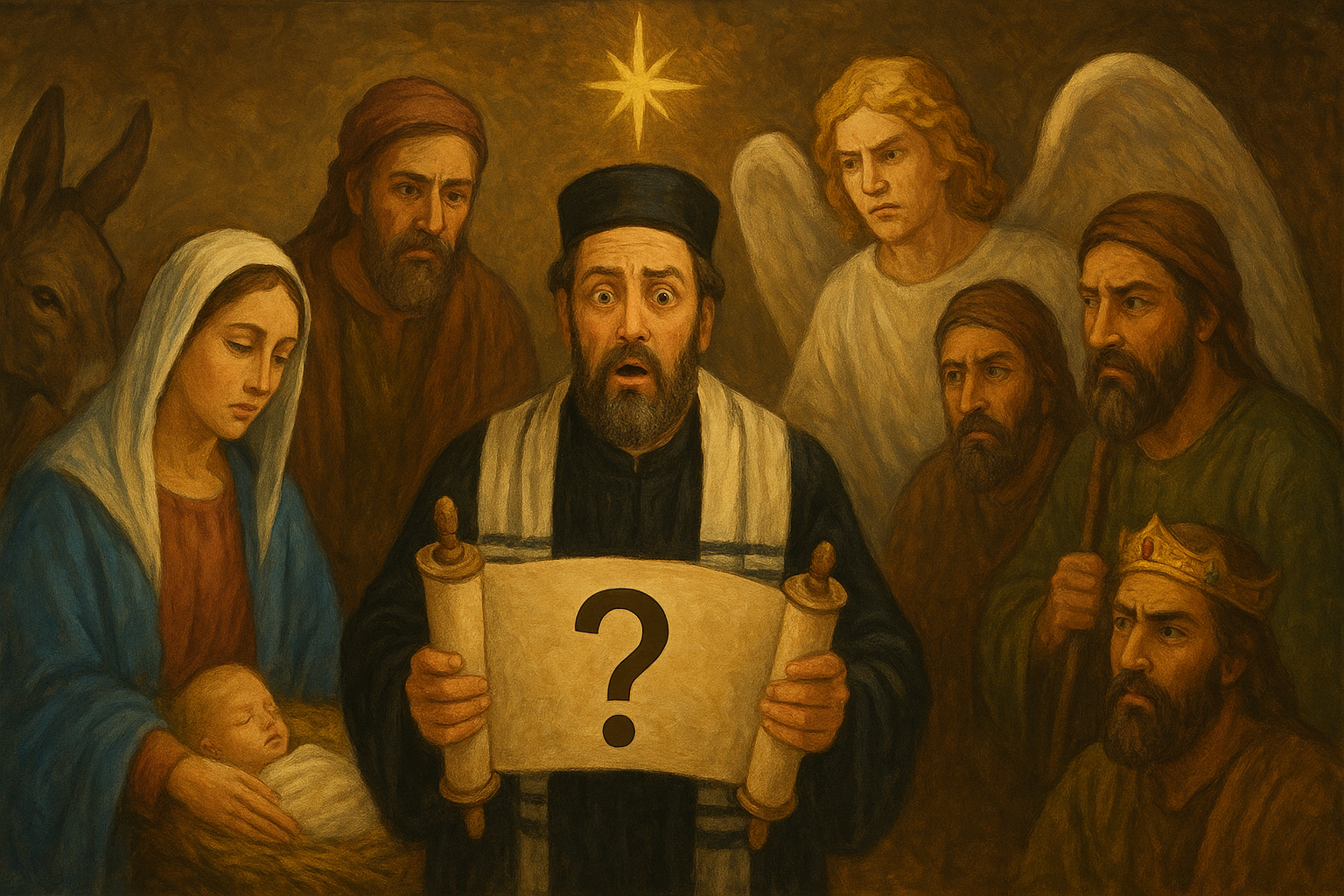
I like that Matthew’s Gospel connects the Old Testament to the New. He’ll include a verse from the Old Testament, followed by something like, “As the prophet Jeremiah said…” or “As was written by the prophet Isaiah…” Matthew wants us to know that Jesus fulfilled Messianic prophecy at His first coming, and I appreciate that he cites his sources.
Except for that time that, well, he didn’t.
Toward the end of the Christmas story, he includes this comment about Jesus and his family moving to a new city:
Matthew 2:23 – And he went and lived in a city called Nazareth, so that what was spoken by the prophets might be fulfilled, that he would be called a Nazarene.
That all sounds, fine, except: which prophet said the Messiah would be called a Nazarene? And it wasn’t just one; Matthew said it was spoken “by the prophets,” which means more than one. And yet you can scour your Old Testament and you will never locate a single verse that says the Christ would be called a Nazarene. In fact, you won’t find a single mention of Nazareth at all.
So what prophecy is Matthew talking about?
The Nazareth Prophecy Problem
Nazareth was a small town; historians estimate that it had 200-400 people. And if there was a prophecy claiming that the Messiah would come from there, it certainly wasn’t on anybody’s mind in the early First Century. When Nathanael heard that the Messiah was there in John 1:46, he remarked, “Can anything good come out of Nazareth?”
Clearly, there was more skepticism than expectation regarding this city.
Perhaps you are thinking: maybe Nazareth had a different name in the Old Testament, and so this prophecy was about the city under a different label.
But that’s not it. Nazareth was established under that name during the Old Testament time- estimated between 900 and 600 B.C. – and it likely existed during the lives of about all the prophets and their writings.
Another possibility to consider: could the prophecies of the Messiah coming from Nazareth have originated outside the Bible? If that sounds impossible, I would point out that we see this in the Book of Jude. It quotes from a prophecy of Enoch that doesn’t show up anywhere in the Old Testament.
However, that doesn’t explain the Nazareth prophecy either. We have no record of any such proclamation from even one prophet.
And no, the city of Nazareth has nothing to do with a Nazirite vow- a practice found in Numbers 6 where, for a period of time, you did not cut your hair or touch a dead body. This was an optional custom for some ancient Jews, but it doesn’t have anything to do with the city of Nazareth or any Messianic prophecies.
So where does Matthew get this idea that multiple prophets predicted that the Messiah would be called a Nazarene?
The Pun Prophecy
This prophecy is unlike any other in Scripture. In the Bible, you have literal fulfillments of various prophecies. You sometimes see dual fulfillments. You have typology and other patterns. But this particular prophecy about Nazareth doesn’t fit any other category; I call it “The Pun Prophecy.”
And I hate to call it that, because I usually avoid puns. Most people I know do not appreciate them. They are generally more likely to elicit groans than laughs.
And yet- as much as I hate to say it- God likes puns. God sprinkles them generously throughout Scripture. We don’t often pick up on them because puns really only work well in their original language.
Samson dropped some wordplay that actually works in both English and Hebrew. But that’s kind of an exception because the rest go right over our head. The first chapter of Micah, for instance, is just a series of puns. He opens that chapter like a stand-up comedian, but of course, the humor is lost on us because it doesn’t have the same ring to it in English. Jesus was also known for his punny phrasing and creative metaphors.
So I guess my sense of humor just needs to become more sanctified because God apparently likes puns a lot. And this prophecy that Jesus would be a Nazarene is a pun.
The Branch Prophecy in the Old Testament
There’s a word used in several Old Testament prophecies about the Messiah that is called, in Hebrew, netzer. This word is translated “branch” in English; as in, a tree branch. A netzer is like one of those big limbs with several smaller limbs growing off of it.
Isaiah 11:1 – There shall come forth a shoot from the stump of Jesse, and a branch from his roots shall bear fruit.
Zechariah 6:12 – Behold, the man whose name is the Branch: for he shall branch out from his place, and he shall build the temple of the Lord.
We also see similar Messianic prophecies using the word Netzer in Jeremiah 23:5 and 33:15, Isaiah 4:2, and Zechariah 3:8.
What’s the connection with Nazareth? The name. Nazareth, in Hebrew, is Netzeret. So Jesus is the Netzer from Netzeret.
And for the record, Netzeret means “The Place of the Branch.” So it actually makes perfect sense that the Messiah, who was often called “The Branch,” would be from “The Place of the Branch.”
It’s a pun- the more scholarly/technical terms could be thematic fulfillment, Hebrew wordplay or literary echo- and God is being quite funny here; it’s just hard for us to see the comedy in it because we read it in English.
Netzer, Nazareth and Hebrew Wordplay
I could invent a modern equivalent, if we can pretend for a moment that the Bible was written in English. Where I grew up on a rural farm, the closest town to our home was called Goodman- which coincidentally wasn’t much bigger than Nazareth. It would probably be met with similar skepticism that the Savior of the World would originate in a little place like that.
Imagine if he had, though. People might naturally question how the Messiah could come from a tiny, obscure town like Goodman. And yet, the irony would be hard to miss: of course the Savior would be a Good Man.
That would be hilarious, and something quite similar happened with the true story. The Messiah was called the Branch, and He grew up in the Place of the Branch.
It’s not the kind of “prophecy” that anybody could have predicted, but it makes perfect sense in retrospect. And Matthew correctly picked up on this clever wordplay from God as he was writing his Gospel account.
God Always Knows What He’s Doing
It’s a good reminder for us in this season of remembrance. Sometimes we question what God is doing with our lives. We don’t always understand what kind of story He’s telling. But this is an example of how God’s plans and promises are often clearer in hindsight than they were in the middle. Someday we will all be able to look back and understand that He always knew what He was doing as the author of our own stories.
And this Christmas, as we’re gathering with our families and that uncle or grandpa starts cracking his old jokes that make the rest of us cringe, consider that maybe his sense of humor is just holier than yours. Our Heavenly Father likes to tell “dad jokes,” too.
This isn’t the only oddity we’ve found in the Christmas story- did you know that Enoch actually prophesied the timing of the coming Messiah? Learn all about it in this episode of the Weird Stuff in the Bible podcast:




Leave a Reply