
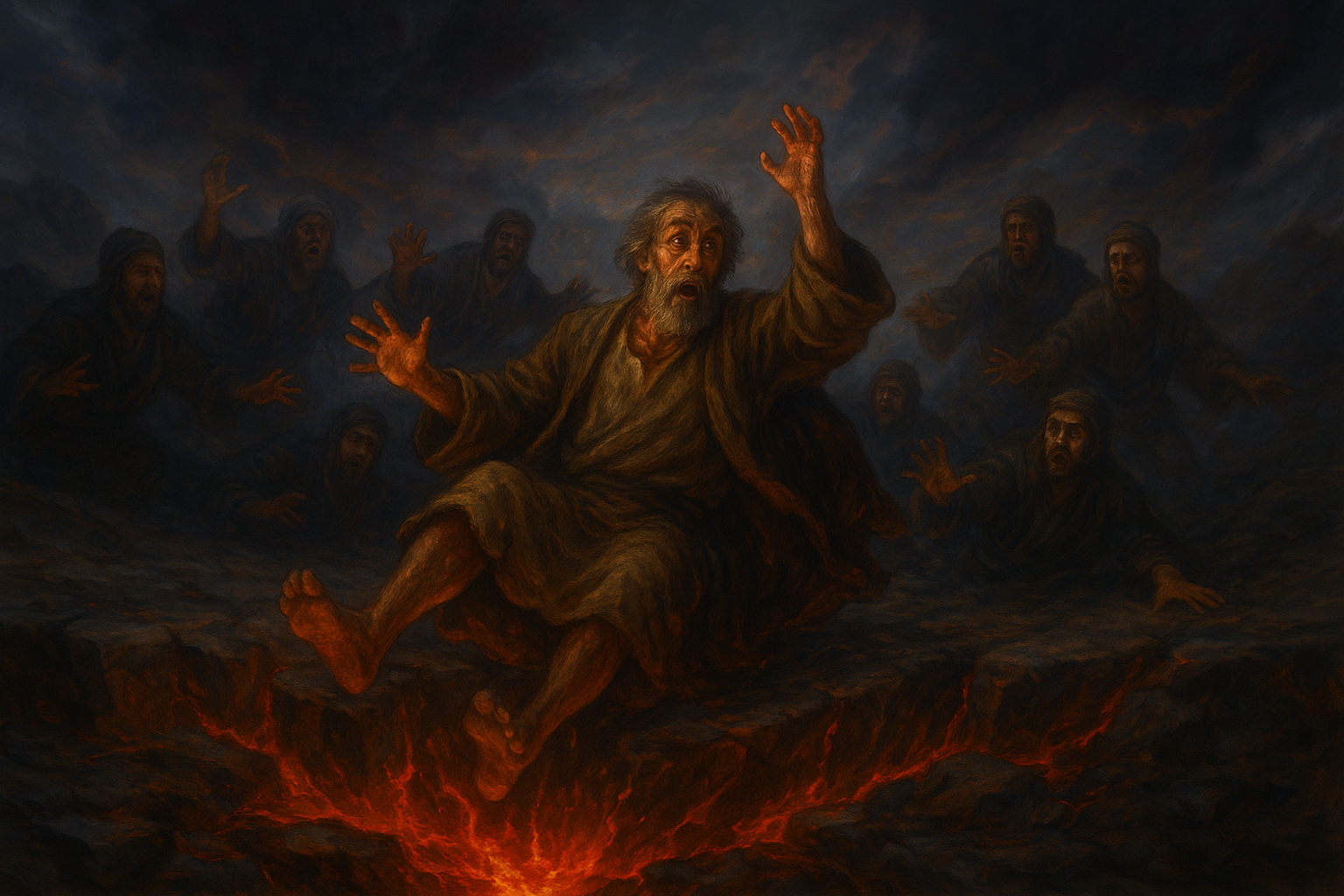
Because yes, there really is a story in the Bible where God opened up the ground and swallowed people alive- straight into the pit of hell. Does this demonstrate that hell itself is a physical place within planet Earth? Let’s investigate the full context.
The Rebellion of Korah: Pride in the Desert
You can find the story in Numbers 16. The Israelites are wandering in the desert, still in that forty-year stretch between Egypt and the Promised Land. Among them is a man named Korah, a relative of Moses from the tribe of Levi.
Korah, along with a few other leaders, decides he’s had enough of Moses’ leadership. He gathers 250 well-known men – “leaders of the congregation, men of renown” – and stages a rebellion.
Their accusation?
Numbers 16:3 – “You take too much upon yourselves, for all the congregation is holy, every one of them, and the Lord is among them. Why then do you exalt yourselves above the assembly of the Lord?”
At first glance, that sounds spiritual — maybe even democratic. But Korah’s issue with Moses isn’t theological as much as it is personal. Korah is jealous of Moses’ position.

He doesn’t like that Moses seems to have all the influence. He’s offended that Aaron is the priest. Korah believes he deserves more authority. As Bible teacher Jon Courson once said, “The spirit of rebellion has its roots in pride, not principle.”
Or as C.S. Lewis put it, “The more we have pride ourselves, the more we dislike it in others.”

“The more we have pride ourselves, the more we dislike it in others.“
-CS Lewis
Moses Falls, Korah Rises
When Moses hears their accusations, he doesn’t defend himself or call for a committee. Instead, he falls on his face before God (Numbers 16:4).
That one gesture tells you who’s in the right. Pride rises up; humility bows down.
Moses doesn’t argue or retaliate. He simply says, “Tomorrow morning the Lord will show who is His.” (Numbers 16:5)
This is the embodiment of meekness- one who knows he doesn’t need to win the argument, because God will handle it.
God Steps In
The next day, the showdown begins. Korah and his followers gather at the entrance of the tabernacle, facing Moses and Aaron.
Then, suddenly, the glory of the Lord appears, and God speaks directly to Moses and Aaron:
Numbers 16:21 – “Separate yourselves from among this congregation, that I may consume them in a moment.”
Moses warns everyone: “If you’re with Korah, stand with him. If you’re with me, get as far away as you can.”
Moments later, the ground beneath Korah and his followers splits open.
Numbers 16:32-33 – The earth opened its mouth and swallowed them up… they and all that belonged to them went down alive into Sheol, and the earth closed over them.
Just like that, the rebellion was over. God made His judgment unmistakably clear.
And then there was one of the most haunting lines in Scripture: “They went down alive into Sheol.”
“Sheol” is the Hebrew word often translated as the grave, the pit, or even hell. So what does this mean? Did these people literally fall into hell itself?
Let’s explore that question.
Is Hell Actually Inside the Earth?
Throughout the Bible, hell is almost always described as “down.” People descend to Sheol. Jesus spoke of being “three days and three nights in the heart of the earth” (Matthew 12:40).
So is hell literally inside our planet’s core?
If you study the earth’s structure, you’ll find the crust, mantle, and then a blazing-hot core – nearly 10,000 degrees Fahrenheit. If hell were physical, that’d be a fitting spot.
And remember: Heaven is also described as “up.” Does that mean it’s physically located beyond the clouds? No one flying a rocket ship has ever found it.
A Russian cosmonaut once said, “We went to space and didn’t see God. He must not be real.” He missed the point entirely.
The Bible speaks in spatial language – “up” for heaven, “down” for hell – not necessarily because of geography, but because of symbolism and perspective. Heaven is high, pure, and lifted up; hell is low, dark, and fallen.
These directions describe spiritual realities, not GPS coordinates.
Heaven, Hell, and the Unseen Realm
So if heaven and hell aren’t physical locations in the sky or the ground, where are they?
The Bible teaches that there’s a spiritual dimension; a realm that operates alongside our physical one. We get a glimpse of this in II Kings 6, when Elisha’s servant panics at the sight of an enemy army. Elisha prays, “Lord, open his eyes,” and suddenly the servant sees another army- one of fiery chariots and heavenly warriors- surrounding them.
In other words: the spiritual world was there all along. He just couldn’t see it. (listen to an episode about that here)

Heaven and hell exist in that same unseen dimension. Heaven “above” us and hell “below” us, both spiritual realities that correspond to the physical world.
So when Korah and his followers were swallowed by the earth, their bodies may have perished pretty quickly on the way down- yet their souls descended immediately into that spiritual realm of judgment.
What Jude Wants Us to Learn
Jude revisits this story in the New Testament because Korah’s fate provides a warning for apostates- those who depart from the Christian faith.
Jude 11 – Woe to them! They have taken the way of Cain; they have rushed for profit into Balaam’s error; they have been destroyed in Korah’s rebellion.
Each of these three names tells us something about the danger of walking away from God.
- Cain represents works over faith – trying to earn salvation on our own terms.
- Balaam represents materialism – chasing money and comfort instead of obedience.
- Korah represents pride and rebellion – resisting God’s appointed leadership.
Together, they form a downward spiral: self-reliance → self-indulgence → self-exaltation.
That’s the road to apostasy. And the destination, Jude reminds us, is destruction — just like Korah’s.
The Old Testament had a lot of words to describe the afterlife: Sheol, hell, heaven, paradise, “Abraham’s Bosom”… Want to learn what they all mean? Check out this Weird Stuff in the Bible podcast episode.



Leave a Reply