
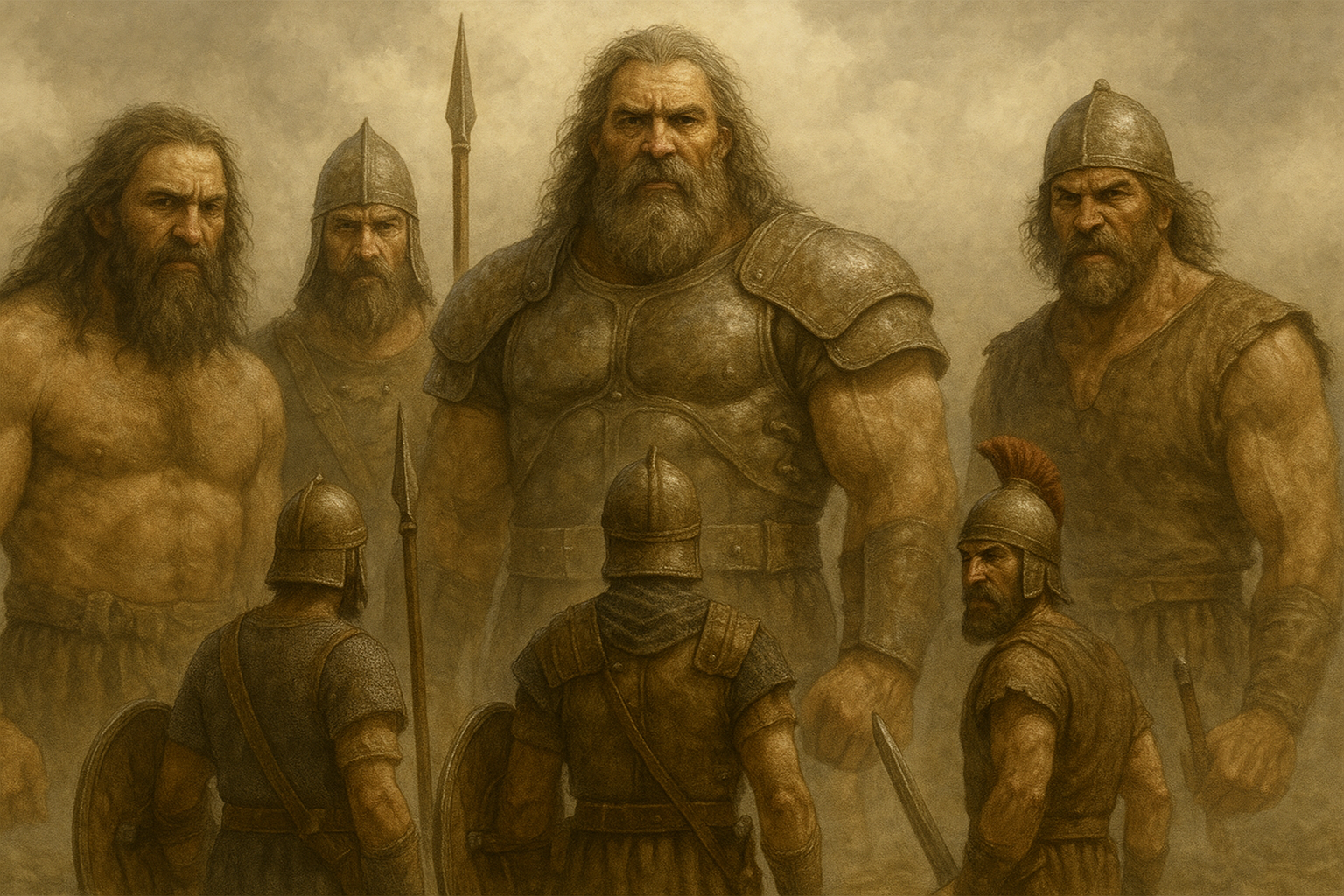
It wasn’t just Goliath.
(In fact, Goliath wasn’t the only Goliath. What? Yeah, we’ll talk about that later.)
There is a race of beings in the Bible who are unnaturally tall and strong. Depending on which translation of the Bible you’re reading from, they may be known as giants, Nephilim or Nephilites. Later, they become known by additional names, which we’ll cover today.
Genesis 6 tells us where they came from.
Genesis 6:1-2, 4 – When man began to multiply on the face of the land and daughters were born to them, 2 the sons of God saw that the daughters of man were attractive. And they took as their wives any they chose…4 The Nephilim were on the earth in those days, and also afterward, when the sons of God came in to the daughters of man and they bore children to them.
This was before the flood of Noah. However, the Nephilim came back after the flood, though the Bible does not explicitly tell us how.

Anak, founder of the anakim
One of the most famous examples of post-flood Nephilim show up when the Israelites were too afraid to take the Promised Land in Numbers.
Numbers 13:33 – “And there we saw the Nephilim (the sons of Anak, who come from the Nephilim), and we seemed to ourselves like grasshoppers, and so we seemed to them.”
There was a new wave of giants right in the land of Canaan, and these were known as the Anakim because they derived from someone named Anak. Who was that? We aren’t sure, but he must have been a prominent giant of the Old Testament world. The Bible brings him up again here:
Joshua 15:13-14 – 13 According to the commandment of the Lord to Joshua, he gave to Caleb the son of Jephunneh a portion among the people of Judah, Kiriath-arba, that is, Hebron (Arba was the father of Anak). 14 And Caleb drove out from there the three sons of Anak, Sheshai and Ahiman and Talmai, the descendants of Anak.
So right there, we have multiple giants of the ancient world listed: Anak, Sheshai, Ahiman and Talmai. It also said Anak was a son of Arba. Considering where the Nephilim came from, it’s possible that Arba is the name of an angelic being, but it seems much more likely that Arba was a Nephilim as well.
So far, we’ve observed five giants and two tribes (Nephilim and Anakim). But Scripture has many more.
Og, king of bashan
Perhaps the most infamous giant in Old Testament history was Og, the King of Bashan. A major turning point in the wilderness wanderings of the book of Numbers is when the Israelites finally defeat Og and his tribe.
Numbers 21:31-35 – 31 Thus Israel lived in the land of the Amorites. 32 And Moses sent to spy out Jazer, and they captured its villages and dispossessed the Amorites who were there. 33 Then they turned and went up by the way to Bashan. And Og the king of Bashan came out against them, he and all his people, to battle at Edrei. 34 But the Lord said to Moses, “Do not fear him, for I have given him into your hand, and all his people, and his land. And you shall do to him as you did to Sihon king of the Amorites, who lived at Heshbon.” 35 So they defeated him and his sons and all his people, until he had no survivor left. And they possessed his land.
How do we know Og was a giant? One major clue is the size of his bed- something Moses highlights when he recounts this story later in Deuteronomy.
Deuteronomy 2:11 – (For only Og the king of Bashan was left of the remnant of the Rephaim. Behold, his bed was a bed of iron. Is it not in Rabbah of the Ammonites? Nine cubits was its length, and four cubits its breadth, according to the common cubit.)
This meant his bed was 13.5 feet long and 6 feet wide. Which means bro was either a giant or taking major steroids. We’ll go with giant today because it also said Og was a remnant of the Rephaim, which are another tribe of Nephilim.
Side note: According to Isaiah 21:13-14, Rephaim (which means shade/ghost) is also a name for the demonic spirits of the giants after they die.
It”s also possible that Sihon- king of the Amorites, neighboring people of the Rephaim- was a giant, but we can’t say for sure. Sihon and Og are often mentioned in conjunction throughout the rest of the Bible.
Goliath and his brothers
During the conquest of Canaan depicted in the book of Joshua, the Israelites drove the Anakim out of the land. The surviving giants migrated to the Philistine cities of Gaza, Gath and Ashdod (Joshua 11:20-21).
The giants of Gath are the most well-known to us, especially Goliath.
I Samuel 17:4 – And there came out from the camp of the Philistines a champion named Goliath of Gath, whose height was six cubits and a span.
We all know this story. David slays the giant with a sling and a stone, and later this young boy grows up to become Israel’s greatest king. What many don’t realize, however, is that this was not the end of David’s giant-killing stories. We see some more mentioned in II Samuel 21- the relatives- perhaps brothers- of Goliath.
II Samuel 21:15-17 – 15 There was war again between the Philistines and Israel, and David went down together with his servants, and they fought against the Philistines. And David grew weary. 16 And Ishbi-benob, one of the descendants of the giants, whose spear weighed three hundred shekels of bronze, and who was armed with a new sword, thought to kill David. 17 But Abishai the son of Zeruiah came to his aid and attacked the Philistine and killed him. Then David’s men swore to him, “You shall no longer go out with us to battle, lest you quench the lamp of Israel.”
Ishi-Benob means “His Dwelling is in Nob,” which was an unfortunate name since he lived in Gath.
II Samuel 21:18 – 18 After this there was again war with the Philistines at Gob. Then Sibbecai the Hushathite struck down Saph, who was one of the descendants of the giants.
Saph means “tall.” Not the most creative name for a giant, but apparently they were running out of names after Ishi-Benob.
II Samuel 21:19 – 19 And there was again war with the Philistines at Gob, and Elhanan the son of Jaare-oregim, the Bethlehemite, struck down Goliath the Gittite, the shaft of whose spear was like a weaver’s beam.
Wait, another Goliath? Actually, there is some evidence that Goliath is more of a title than a name, perhaps meaning the mightiest giant. After David had killed the previous Goliath, perhaps Elhanan slew the next Goliath.
There is a parallel account in I Chronicles 20:5, which gives this giant the name “Lahmi.”
And finally, this section mentioned one more giant, who had no name but a rather interesting physical attribute.
II Samuel 21:21-22 – 20 And there was again war at Gath, where there was a man of great stature, who had six fingers on each hand, and six toes on each foot, twenty-four in number, and he also was descended from the giants. 21 And when he taunted Israel, Jonathan the son of Shimei, David’s brother, struck him down. 22 These four were descended from the giants in Gath, and they fell by the hand of David and by the hand of his servants.
Why the extra digits? While we can’t say for sure, we do know that these giants were created because the Watchers messed with human DNA. Perhaps, then, the Nephilim were more prone to genetic mutations.
Of note: there are other stories of giants in historical record, and it’s not uncommon to read of them having extra fingers and toes- not to mention a particularly devious villain in The Princess Bride.

My name is Ishi-Benob. You killed my brother. Prepare to die.
So for those of you keeping track, here are the named giants of the Bible:
- Anak
- Og
- Sihon (possibly)
- Arba
- Sheshai
- Ahiman
- Talmai
- Goliath
- Ishi-Benob
- Saph
- Lahmi
- The six-fingered “man”
Now let’s wrap up by covering the various tribes of the giants.
The 5 Giant Tribes of the Old Testament
There are five tribes of giants spoken of in the Old Testament. Three, we have already covered:
- Nephilim (the originals)
- Anakim
- Rephaim
- Emim
- Zuzim/Zamzuzim
We’ll first note that not every people group said to have giants is itself a Nephilim race. For example, the Philistines often had giants living among them, but most of the Philistines themselves were not giants. The same with the Canaanites, which referred to a variety of types of people, including giants. Likely the same with the Amorites.
Amos 2:9 – Yet it was I who destroyed the Amorite before them,
whose height was like the height of the cedars
and who was as strong as the oaks;
I destroyed his fruit above
and his roots beneath.
Because the Amorites lived in such close proximity to the Rephaim and Og, King of Bashan- and because their height is described in this way- and because they’re repeatedly mentioned in scripture alongside Bashan- it seems probable that they had some giants among them and that their king, Sihon, was a giant himself. However, the Bible never explicitly says this, and not every Amorite was a giant.
The Emim, however, were.
Emim
In Deuteronomy 2-3, as Moses is recounting the history of the Israelites and their wilderness wanderings, he mentions another tribe of giants who had already been wiped out by other people.
Deuteronomy 2:10-12 – 10 (The Emim formerly lived there, a people great and many, and tall as the Anakim. 11 Like the Anakim they are also counted as Rephaim, but the Moabites call them Emim. 12 The Horites also lived in Seir formerly, but the people of Esau dispossessed them and destroyed them from before them and settled in their place, as Israel did to the land of their possession, which the Lord gave to them.)
Emim means “the terrifying ones.” The Emim broke off the Rephaim and lived in the territory of the Moabites. However, they were already wiped out prior to Moses and crew arriving on the scene. In fact, we’ll get a clue about when that was in just a minute.
Zuzim/Zamzummim
Moses also mentions another giant group from those days: the Zamzummim, which means “buzzers.”
Deuteronomy 2:17-22 – 17 the Lord said to me, 18 ‘Today you are to cross the border of Moab at Ar. 19 And when you approach the territory of the people of Ammon, do not harass them or contend with them, for I will not give you any of the land of the people of Ammon as a possession, because I have given it to the sons of Lot for a possession.’
20 (It is also counted as a land of Rephaim. Rephaim formerly lived there—but the Ammonites call them Zamzummim— 21 a people great and many, and tall as the Anakim; but the Lord destroyed them before the Ammonites, and they dispossessed them and settled in their place, 22 as he did for the people of Esau, who live in Seir, when he destroyed the Horites before them and they dispossessed them and settled in their place even to this day…)
These “buzzers” also broke off the Rephaim, like the Emim did, and they lived in the land of the Ammonites.
I mentioned in the previous article that we don’t quite know how far back the second-wave Nephilim originated, but it must have been pretty early after Noah’s flood. The Rephaim, Emim and Zuzim/Zamzummim are already present in a story of Abraham’s nephew, Lot, getting kidnapped in the book of Genesis.
Genesis 14:5-6 – 5 In the fourteenth year Chedorlaomer and the kings who were with him came and defeated the Rephaim in Ashteroth-karnaim, the Zuzim in Ham, the Emim in Shaveh-kiriathaim, 6 and the Horites in their hill country of Seir as far as El-paran on the border of the wilderness.
There you have it: all the Nephilim of the Bible- the five tribes, as well as those with specific names or stories. Find any we missed? Contact us and let us know!
Want more information on how the spirits of the dead Nephilim became the demons of the New Testament? Listen to this episode of the Weird Stuff in the Bible podcast to find out more:

Leave a Reply