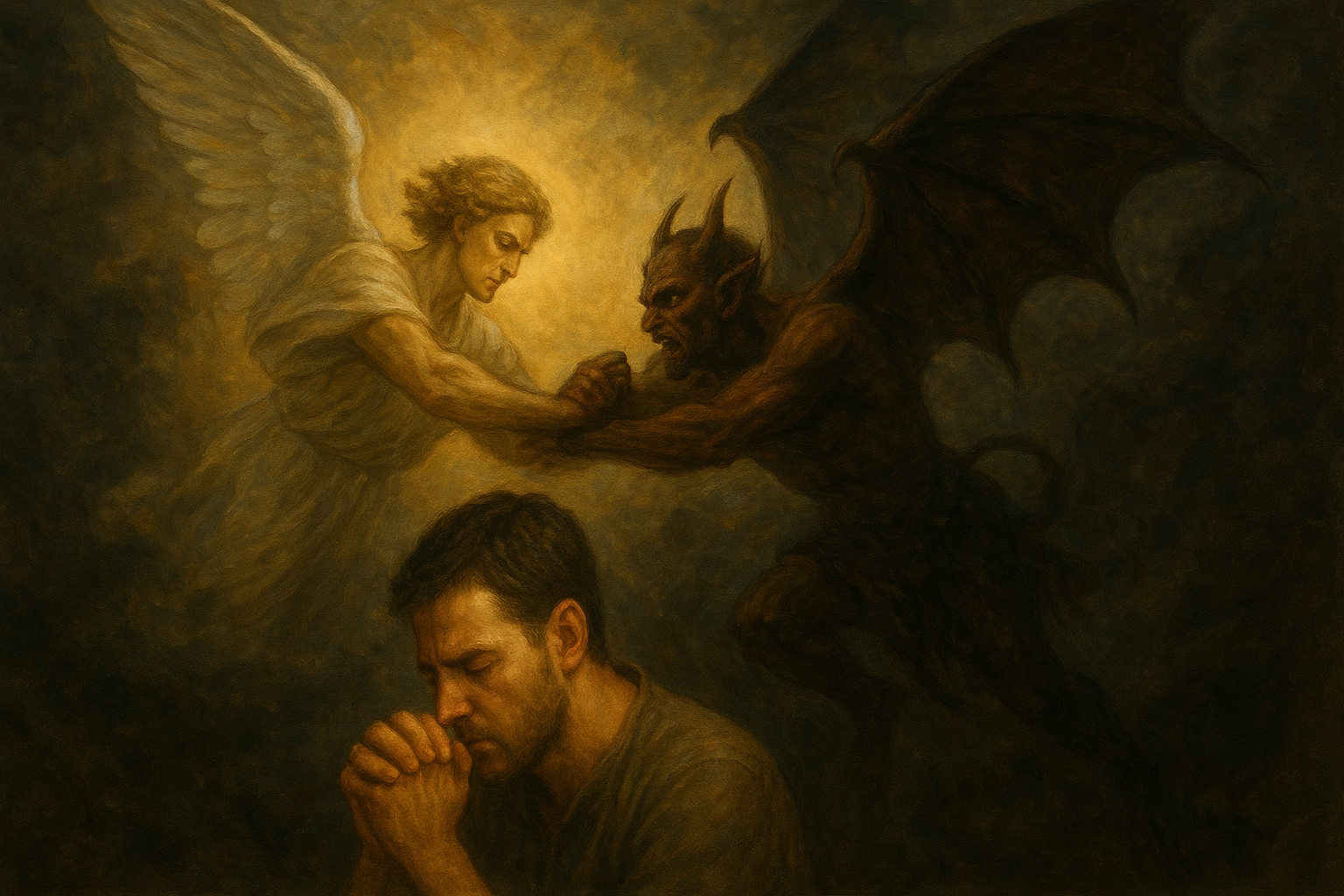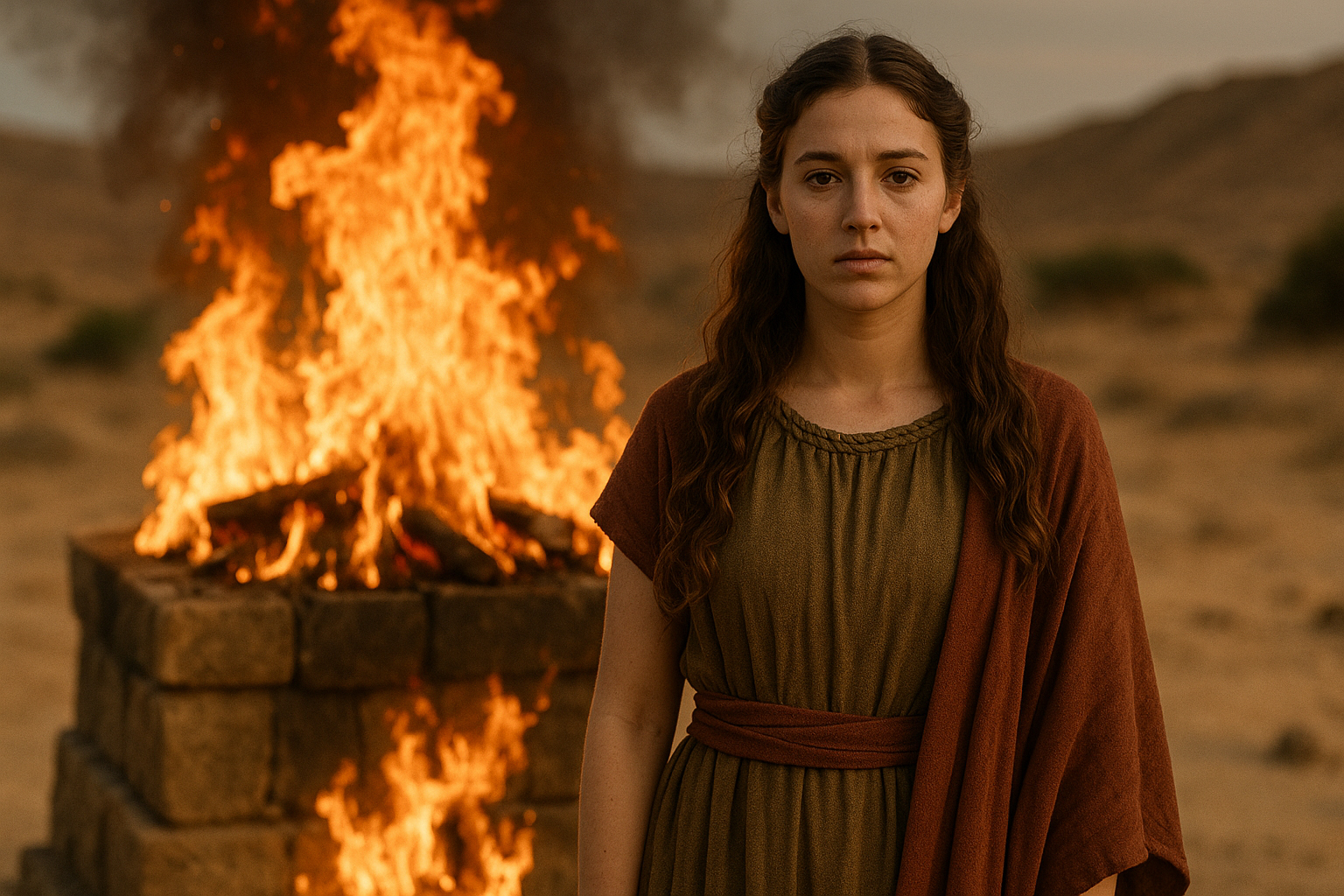
One of the saddest stories in the Old Testament is the tragic account of Jephthah’s daughter. But when we examine the original Hebrew, we may find a clue that makes the story- while not a happy one- a bit less horrifying. It may also makes sense of some other confusing details later in the account.
Just before going off to war against the Ammonites, Jephthah made this foolish vow:
Judges 11:31-32 – “If you will give the Ammonites into my hand, then whatever comes out from the doors of my house to meet me when I return in peace from the Ammonites shall be the Lord’s, and I will offer it up for a burnt offering.”
It was traditional for kings or generals going off to war in those days to make some kind of commitment to their deity like this; that upon victory, they will offer some kind of sacrifice. It was not necessary for Jephthah to do this, as God already desired Jephthah’s victory.
And sadly, upon returning from the battle with a win, Jephthah’s daughter is the first to come out the door.
Judges 11:35-40 – 34 Then Jephthah came to his home at Mizpah. And behold, his daughter came out to meet him with tambourines and with dances. She was his only child; besides her he had neither son nor daughter. 35 And as soon as he saw her, he tore his clothes and said, “Alas, my daughter! You have brought me very low, and you have become the cause of great trouble to me. For I have opened my mouth to the Lord, and I cannot take back my vow.”
What was Jephthah thinking?
The conventional idea is that surely he must have intended for an animal (such as a household pet or barnyard critter) to come through his door rather than a person. We will challenge that notion today.
Courageously, Jephthah’s daughter submits to the vow her father spoke, insisting that he keep his word despite whatever happens to her.
Judges 11:36-40 – 36 And she said to him, “My father, you have opened your mouth to the Lord; do to me according to what has gone out of your mouth, now that the Lord has avenged you on your enemies, on the Ammonites.” 37 So she said to her father, “Let this thing be done for me: leave me alone two months, that I may go up and down on the mountains and weep for my virginity, I and my companions.”
38 So he said, “Go.” Then he sent her away for two months, and she departed, she and her companions, and wept for her virginity on the mountains. 39 And at the end of two months, she returned to her father, who did with her according to his vow that he had made. She had never known a man, and it became a custom in Israel 40 that the daughters of Israel went year by year to lament the daughter of Jephthah the Gileadite four days in the year.
It is curious that, upon hearing she was to be made a burnt sacrifice, she bewailed her virginity. For Jephthah himself, this meant the end of his family line. It is a very sad and shocking story from a dark time in Israel’s history.
Most commentators agree that Jephthah acted foolishly in this story. Most pastors use this text to reinforce the gravity of our vows and keeping our word. And most Bible readers conclude that Jephthah’s daughter must have been literally sacrificed at the end of this story.
But did Jephthah’s Daughter truly die? An alternative view.
However, there is one word in Jephthah’s original declaration that may have been misunderstood by our translators.
Judges 11:31-32 – “If you will give the Ammonites into my hand, then whatever comes out from the doors of my house to meet me when I return in peace from the Ammonites shall be the Lord’s, and I will offer it up for a burnt offering.”
The word “and” in this sentence is the Hebrew conjunction waw (or vav), which can be translated a few ways. Most commonly it is translated as “and,” but it can also be rendered “or.”
Which means that Jephthah’s statement can easily be read this way: whatever comes out from the doors of my house to meet me…shall be the Lord’s, or I will offer it up for a burnt offering.
Changing that “and” to an “or” completely changes the outlook on the situation. Jephthah was perhaps actually implying one of two possibilities: that whatever came out the door of his house would either be dedicated to God or offered up as a burnt offering.
The disjunctive vs the conjunctive
We’ll also note that the word “whatever” in Hebrew is yasa, which means anyone or anything. This means Jephthah was cognizant of the potential that what he was offering to the Lord might be a person. But he had not prepared for the possibility that it might be his daughter. He may have been expecting a servant, slave or handmaid to walk through the opening.
Waw/vav is usually translated “and” (the conjunctive use). However, it is also translated “or” when used in conditional scenarios where one of two outcomes is possible, not both. Grammarians call this the disjunctive use of the word.
Therefore, what Jephthah was saying with his vow was that if a person walked through his door, he or she would be dedicated to the Lord for the rest of their life; or if an animal walked through, it would be given as a burnt offering.
This reading is completely consistent with the Hebrew. It could easily be read as a conditional scenario where only one of two outcomes is possible. If a person, dedicated to the Lord. If an animal, offered as a sacrifice.
So what happened to Jephthah’s daughter?

If she was dedicated to the Lord, it meant she was committed to tabernacle service for the rest of her life. She would not be able to marry, which explains why she bewailed her virginity upon finding out about the vow.
Being dedicated to tabernacle service meant she would produce no heirs. Since she was Jephthah’s only child, his family line would end with her.
Samuel’s mother dedicated him to tabernacle service from his birth (I Samuel 1). He was able to marry and bear children, but as a male, his wife came to live with him. As a woman, if she were to marry, she would have to leave the tabernacle to live with her husband. Thus, Jephthah’s daughter could not realistically marry.
This interpretation makes sense of why his daughter’s virginity was lamented rather than her life itself (Judges 11:39-40). It also avoids many difficult questions regarding how a literal human sacrifice would have been allowed by the Israelite society.
However, this is also a minority view among scholars. Most conservative scholars believe Jephthah indeed offered his daughter. This is also the dominant view in ancient Jewish sources.
Regardless of whether Jephthah dedicated his daughter to the service of the Lord or actually sacrificed her, the question persists: was it right for him to offer her up as a burnt offering? This episode of the Weird Stuff in the Bible podcast seeks to answer that question: